After 23 years and more than 5,000 vehicles, I can tell you the concept is simple but the execution is anything but. Every vehicle, every storm, and every panel is a different puzzle. The walkthrough that follows is the exact sequence your vehicle moves through at 2109 E Kansas City Rd, #22, in Olathe.
Key takeaways
- Paintless dent repair is a metal-finishing process, not a painting process — no filler, no sanding, no respray.
- Every vehicle starts under LED line boards, which reveal the 60 to 70 percent of damage the naked eye misses.
- Most dents are pushed out from behind with precision rods; panels with no rear access use the glue-pull method.
- Aluminum and high-strength steel need heat-assisted technique, which is why aluminum runs 30 to 50 percent longer and carries a 25 percent markup.
- Factory paint stays intact, so there is no CARFAX repaint record and no diminished resale value.
What happens first when my vehicle arrives?
Every vehicle starts under the LED line boards. These are banks of striped LED tubes whose reflection reveals every deformation in painted metal. A dent that is invisible under normal light becomes obvious under line-board reflection, because the stripe pattern distorts exactly where the metal has moved. Line boards expose 60 to 70 percent of damage that the naked eye misses entirely, which is why driveway estimates and parking-lot glances come in so low.
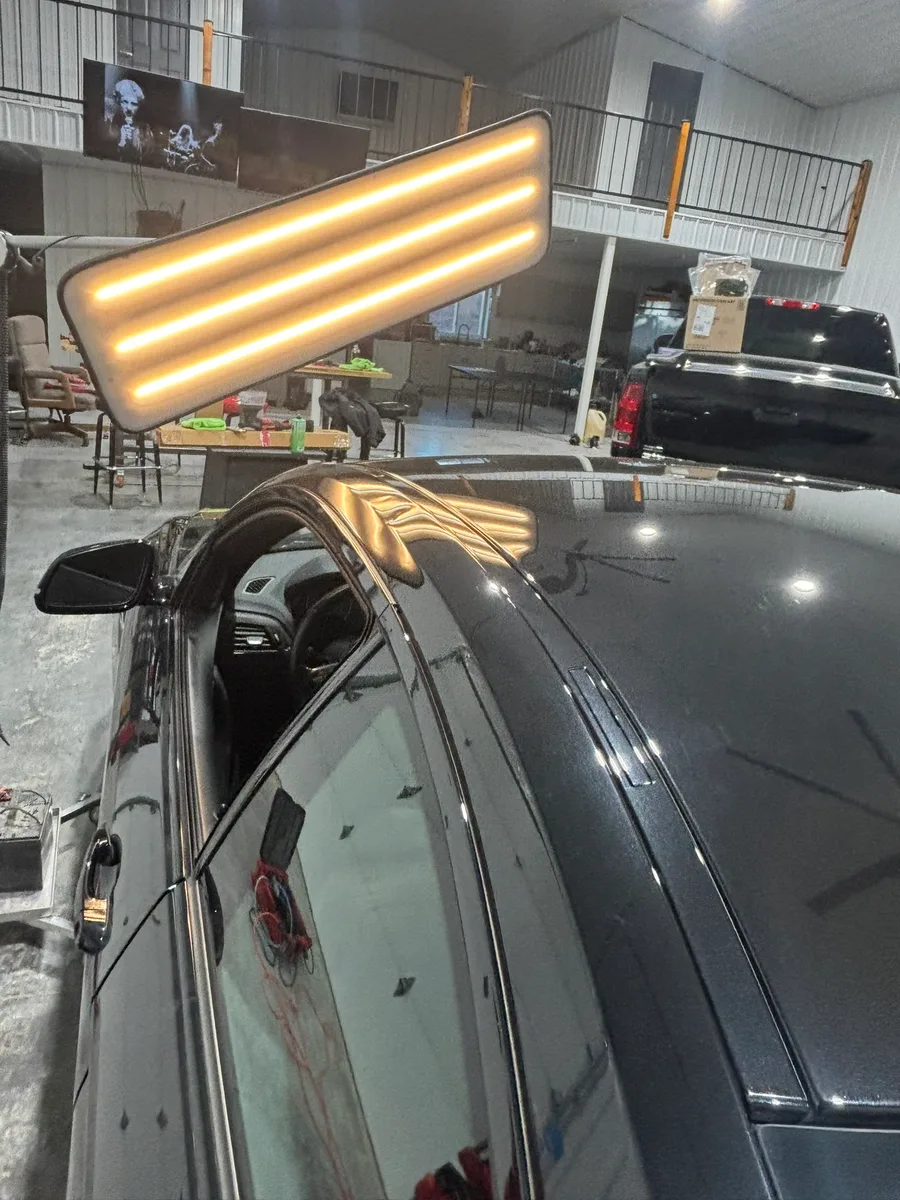
We walk the vehicle panel by panel and count dents by size classification — dime, nickel, quarter, half-dollar — noting how they spread across each panel. That count drives the CCC ONE estimate. CCC ONE is the dominant estimating system in the industry, used by roughly nine in ten shops and carriers, and its pricing matrix is built on exactly this kind of size-by-size documentation.
The inspection runs 30 to 45 minutes on a moderately damaged vehicle. We photograph each panel under the boards and mark the count on a body diagram. That documentation becomes the foundation for the insurance supplement, and it is the single most important step in getting your claim paid correctly. A sloppy count here is money that quietly disappears from the estimate. How supplements work.
How do you plan access to each dent?
Most dents are repaired from behind the panel. That means removing trim, the headliner, door panels, and sometimes the fender liner so the rods can reach the back surface. An experienced technician maps this before touching metal — some dents call for pulling five or six trim pieces, while others can be reached through an existing body opening.
Access planning is where experience saves time and prevents damage. A newer technician tends to start removing parts immediately. After 23 years, I walk the vehicle and mentally map every access point before a single clip comes off. The hood is straightforward — prop it open, work from underneath. The roof needs headliner removal, which pulls in the A-pillar trim, sun-visor brackets, and dome-light housings. Quarter panels are the hardest, often requiring tail-light removal and inner-fender work to reach the back side.
R&I — remove and install — is billed as its own line item on the estimate. It is real labor, and it protects your interior trim during the repair. Shops that skip R&I and try to work around trim in place leave behind scratched panels and broken clips.
What does the push method with rods actually do?
Paintless dent repair rods run from six inches to more than five feet, with tips shaped for different dent geometries — round for shallow circular dents, curved for body lines, sharp for creases. The technician slides the rod through the access point, finds the back of the dent by touch, and pushes outward in small increments. Each dent typically takes anywhere from 30 seconds to a few minutes.
The art is knowing exactly how much force to apply. Push too hard and you raise a high spot; push too little and the dent does not fully return. This is why the craft takes years — it is almost entirely tactile. You cannot see the rod tip behind the panel, so you feel the metal yield, watch the line-board reflection respond in real time, and adjust pressure and position with every micro-push.
Rod selection matters more than most people realize. A dent in the center of a flat hood wants a wide-tip rod and gradual pressure. A dent on a crowned fender near a body line needs a narrow tip and precise placement, because a millimeter off pushes a new distortion into the line. After 5,000-plus vehicles the choice is instinctive, but that instinct was built through years of trial and error.
What happens when a panel has no rear access?
Some panels simply do not allow access from behind. Modern truck beds, Tesla doors, and certain aluminum hoods bond the metal to structural elements that block rod work. For those, we use the glue-pull method: a plastic tab is bonded to the outer panel with hot-melt glue, a slide hammer or mini-lifter is attached, and the dent is drawn outward from the front.
After the pull, high spots are tapped down with a knockdown tool — a smooth-tipped tool used with a light hammer — and the tab releases cleanly with alcohol. No paint is disrupted at any stage.
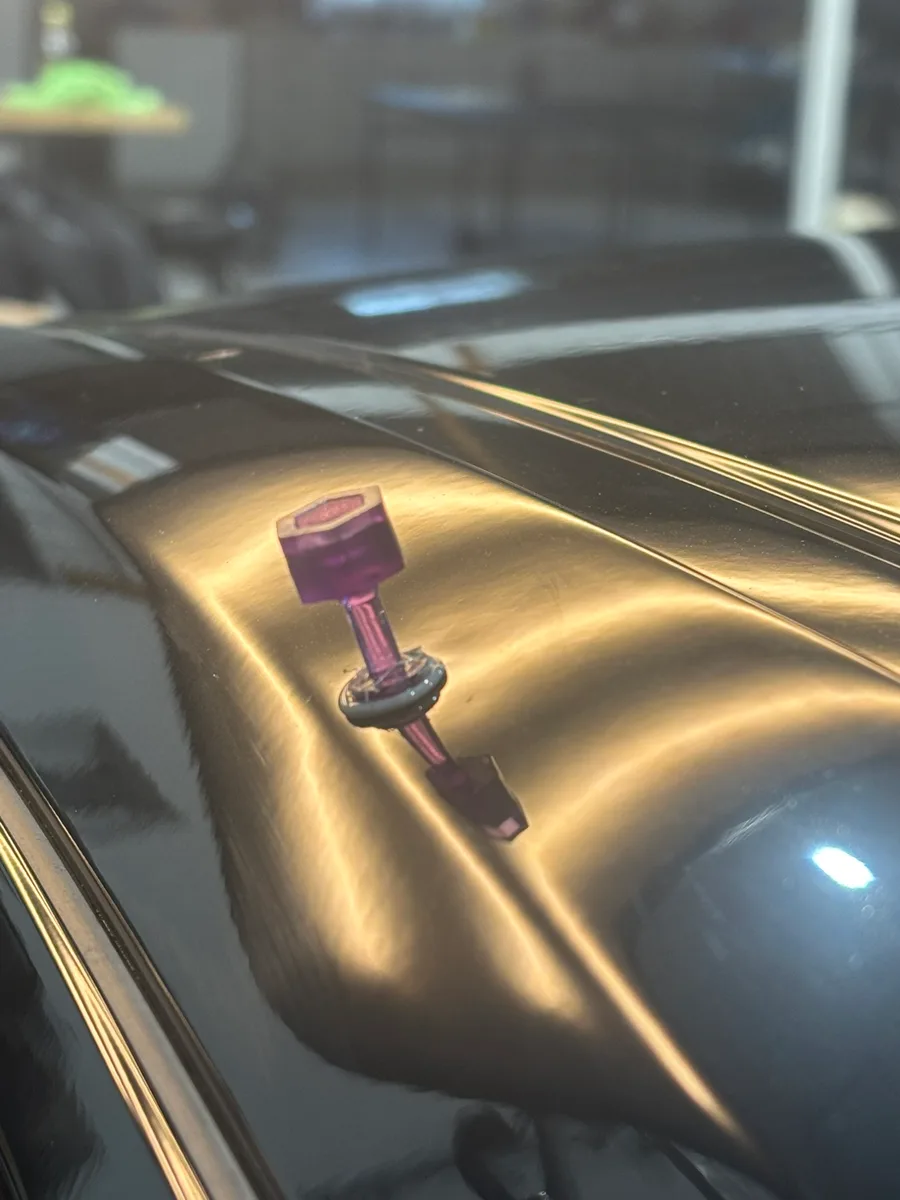
Glue-pull technology has improved dramatically over the last decade. The adhesives are temperature-specific, so we use one formulation on a hot summer panel and another on cold winter metal. The tabs come in dozens of shapes and flexibility levels: a rigid tab on a shallow dent delivers maximum pulling force, while a flexible tab on a complex curve conforms to the surface and pulls more evenly. Matching tab, glue, and temperature is another layer of judgment that separates a competent technician from a great one.
Why does aluminum need heat?
Aluminum and high-strength steel lack the elasticity of mild steel. For those materials we apply magnetic induction heat — on the metal only, never on paint — bringing the panel to roughly 140 to 170°F, soft enough to work without harming the finish. This is part of why aluminum hail repair runs 30 to 50 percent longer and carries a 25 percent markup.
Aluminum panels have memory characteristics that differ from steel. Push a steel dent and the metal tends to stay where you put it. Aluminum wants to spring back, sometimes toward its original shape and sometimes not. Heat relaxes that spring tension so the metal can be shaped predictably. Without it, aluminum work produces inconsistent results and a higher risk of cracked paint.
High-strength steel — HSS and ultra-high-strength steel — turns up on roof rails, B-pillars, and structural reinforcements. These panels are engineered to resist deformation in a crash, which means they also resist repair force, so heat-assisted technique is essential. We see this steel on more vehicles every model year as manufacturers chase crash-safety ratings.
How do you finish a panel so the repair is invisible?
Once the major dents are out, the technician goes back over the panel under the boards looking for micro-imperfections — small high spots, shallow residual dents, faint ripples. Those get massaged out with smaller tools and a touch of heat where needed. When the line-board reflection reads completely flat across the panel, the panel is done.
Blend finishing is where the patience lives. The big dents come out relatively fast — that is the satisfying part. But a panel that had 40 dents removed still carries subtle unevenness between them, and chasing that last five percent of perfection takes as long as the first 95. A rushed technician delivers "good enough" here; a patient one delivers invisible. We do not release a vehicle until the reflection is clean.
What happens before I get my keys back?
All the removed trim goes back on. Headliners are reinstalled, door panels re-clip, and we run a final inspection under the boards, wash the vehicle, and hand it back. Total shop time is one to three days for moderate damage, three to seven for severe, and four to eight for a full aluminum vehicle.
Our quality-control pass is a separate step from the technician's own work. A different set of eyes walks the vehicle under the line boards after reassembly, because fresh eyes catch things the working technician may have normalized over hours of staring at the same panel. If anything falls short, it returns to the bay before you ever see it.
What does Bryan notice under the line boards?
After 23 years of reading hail damage under LED line boards, certain patterns jump out at once. The first is the storm signature: every hailstorm leaves a characteristic pattern based on wind direction and stone size. Strong southwest winds concentrate damage on the hood, left fender, left doors, and roof. A straight-down storm hits the roof and hood evenly and leaves the sides nearly untouched.
The second thing I look for is prior damage. About one vehicle in five carries earlier dent work from a previous storm or a parking-lot incident. Sometimes it was paintless dent repair, which is fine — we can work over previous paintless dent repair. Sometimes it was body filler, which changes everything, because filler absorbs push force and makes that area impossible to work. I can spot filler in about two seconds under the boards, since it does not reflect the way factory metal does.
The third observation is paint condition. Factory paint from the last ten years is remarkably flexible and survives the process well. But some colors — deep metallic blacks and dark blues especially — show stress marks more easily if a technician works too aggressively. Paint that is 15 years or older turns brittle and runs a higher risk of cracking. I assess age and condition before quoting, because both affect technique and warranty.
The most common surprise for customers is how much damage exists beyond what they saw in the driveway. A vehicle that looks like "maybe 20 dents" in sunlight routinely reveals 150 to 200 under the boards. That hidden 60 to 70 percent is the reason the cost of hail repair lands higher than most people expect from a visual estimate.
What do I have to do as the customer?
Your involvement is minimal by design. After you start the free walkthrough or call us at (816) 451-1455, the typical experience is this: we schedule a free inspection, walk your vehicle under the boards with you — you are welcome to watch, and most people find it fascinating — and produce a documented estimate. If you have already filed with your carrier, we prepare the supplement. If you have not, we show you exactly how to file your own claim and hand you the script for your carrier.
Once the repair is scheduled, we pick the vehicle up or you drop it off. During the work we send updates every 24 to 48 hours, usually a quick text with a progress photo. If the supplement needs revision — an adjuster occasionally pushes back on a line item — we coordinate that conversation as part of the repair. You file the claim; we never file it for you, and you never have to chase anyone once it is approved.
When the vehicle is finished, we deliver it back or you pick it up. From your side the whole thing is one inspection visit, hand over the keys, get the keys back — roughly 30 minutes of active time across the entire repair. That is the concierge model we have built over two decades.
How does insurance fit into the repair?
Insurance and the repair run in parallel, not one after the other. The first insurance estimate — from an adjuster visit, a drive-in catastrophe site, or a photo app — almost always lands 20 to 40 percent below the real repair cost. That is not bad faith; it is a limit of the inspection method. Adjusters work in natural light or with a flashlight, while we inspect under LED line boards that reveal far more.
The supplement bridges that gap. We submit our line-board-documented estimate as a supplement to the carrier, the carrier reviews it — usually approving within one to two business days — and issues a revised payment. Occasionally a second round follows if more damage surfaces once trim comes off, which is normal and expected. The full supplement breakdown is here.
Comprehensive hail claims generally do not raise your premium. Hail is classified as an act of God — a not-at-fault event — and most carriers in Kansas and Missouri treat comprehensive claims differently from collision claims at renewal. Nearly every first-time customer asks about this, and in most cases it is not something to worry about. The detailed rate-impact guide is here.
Why does this craft take years to master?
The barrier to entry is time, not equipment. A full professional tool kit runs $5,000 to $10,000. The training to use it well takes two to three years of full-time practice for basic competency and five-plus to handle aluminum, deep creases, and body-line dents. There is no shortcut around the repetitions.
The skill is entirely tactile. You cannot see the rod tip behind the panel, so you feel the resistance of the metal, judge your distance from the dent center by feedback through the rod, and modulate force in real time while watching the reflection. Early-career technicians describe it as writing your name while looking in a mirror — every instinct is backward until it gets retrained.
Hail work specifically demands volume experience. A door-ding technician might fix five to ten dents per vehicle; a hail technician fixes 50 to 500 across every panel type, body line, and material. The variety one hail technician sees in a single week would take a door-ding technician months. That is why out-of-state operators who chase storms produce inconsistent results next to a permanent shop that does hail repair as its primary work, year-round.
Why is paintless dent repair the cleaner choice?
It is one of the cleanest repair processes in the automotive industry. No chemical solvents, no paint vapors, no filler dust, no hazardous waste. The tools are mechanical, the energy input is human force and the occasional induction heater, and the output is a restored panel with no material waste.
Compare that to a body-shop repair on the same vehicle. A moderate hail repair there involves sanding compound, filler, primer, base coat, clearcoat, and thinners — all releasing volatile organic compounds that require ventilated spray booths and hazardous-waste disposal. The EPA regulates auto-body paint emissions for good reason, and paintless dent repair sidesteps the whole chain.
For the growing number of customers who weigh environmental impact, the choice is clear on every dimension. No waste, no emissions, no chemicals — and your factory paint stays on the vehicle rather than being sanded off and replaced with aftermarket coatings.
What can't paintless dent repair fix?
Four scenarios send a panel to a body shop.
- Cracked or chipped paint, where the finish itself is already damaged.
- Dents on a sharp body-line fold, some of which are repairable and some of which need replacement.
- Panels previously repaired with filler, since filler absorbs the push force.
- Damage severe enough that repair cost approaches the cost of replacing the panel, which is rare on hail and occasional on severe single-panel damage.
We tell you at intake whether your vehicle is a paintless dent repair job or a body-shop job. Most hail damage is pure paintless dent repair. In about ten percent of cases a vehicle needs a combination — paintless dent repair on most panels and a body shop on one or two with cracked paint — and we coordinate that when it applies. The full comparison is here.
Honesty at this stage saves everyone time. If a panel cannot be repaired with paintless dent repair, we say so immediately rather than attempt work that will look mediocre. You benefit because the correct repair path starts sooner. The carrier benefits because the claim is documented accurately from day one. And we benefit because our reputation rests on vehicles that leave the shop looking like the storm never happened.
How do I get a free line-board inspection?
A free line-board inspection takes about 30 minutes and gives you the complete picture of your hail damage, including the 60 to 70 percent that is invisible in your driveway. We produce the CCC ONE estimate, walk you through the repair plan, and prepare the supplement documentation from start to finish.
Start the free walkthrough or call us at (816) 451-1455. We will schedule your inspection within 48 hours, and you will know exactly where you stand before you commit to anything. Here is how long the full process takes.