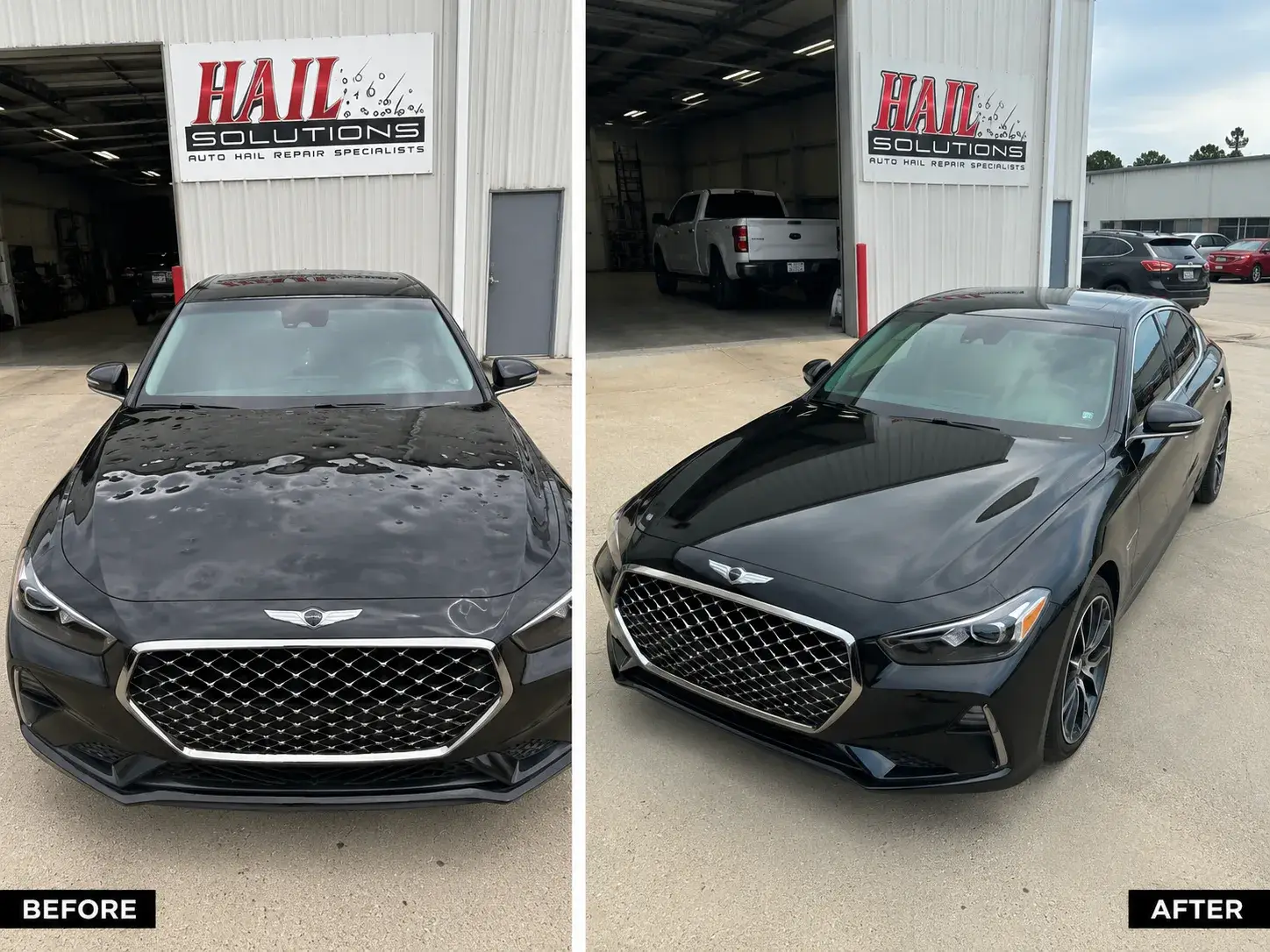
300+ dents. Still savable.
Get a second opinion before you sign the title over. When an adjuster calls a hail-damaged vehicle a total loss, the math is usually built on body-shop pricing — replacing panels you do not need replaced. Most severely hailed cars can be restored with paintless dent repair for far less, keeping the factory paint, a clean vehicle history, and the resale value intact.
Repaired by hand at our Olathe shop · 23 years and 5,000+ vehicles · lifetime warranty in writing.
Why estimators default to "total loss" on severe hail
The number that triggers a total-loss call is almost always built on the wrong repair method.
Adjusters price severe damage in the body-shop model by default
The estimating software assumes severe damage means panel replacement. On a roof, hood, or several doors that adds thousands per panel in parts, labor, and paint. Spread it across a vehicle with 300-plus dents on every panel and the repair cost climbs past the total-loss line fast — a roof replacement alone can run $4,000 to $6,000 at a body shop.
Paintless dent repair does not follow that math. We do not replace panels, repaint, or use body filler, so a full-vehicle restoration — even on a car with 400-plus dents — typically runs $8,000 to $18,000 rather than $30,000 or more. A vehicle the adjuster was ready to write off comes in well under the threshold and can be saved.
The catch is documenting the real cost. We re-inspect under LED line boards, map every dent panel-by-panel, and write it up in CCC ONE format so the insurer sees an apples-to-apples paintless dent repair cost against the original body-shop estimate. You file the claim with your carrier; we never file it for you. We give you the script, you make the call, and once it is approved the repair is ours.
Missouri and Kansas draw the line in different places
Which side of the state line your vehicle is registered on genuinely matters on a severe-damage claim.
Kansas: 75% of actual cash value
Kansas sets the total-loss line at 75% of a late-model vehicle's fair market value, and the law leaves merely cosmetic hail damage out of the salvage calculation (K.S.A. 8-197(b)(2)(B)). A cosmetically dented car generally should not be branded a total loss on that basis alone.
Missouri: 80% of actual cash value
Missouri sets the line at 80% of a late-model vehicle's fair market value, with a cosmetic-hail carve-out sitting in front of it (RSMo 301.010(55)(a)). A hail-dented vehicle generally should not be totaled on cosmetic damage alone.
Actual cash value (ACV) is what your vehicle is worth today — usually a KBB or NADA figure adjusted for condition. Get your insurer's ACV number in writing before you accept any total-loss offer, because once you sign the title over, the decision is final. Our full total-loss guide walks through the numbers.
This is general information, not legal advice — your situation depends on your policy, your carrier, and your vehicle's age.
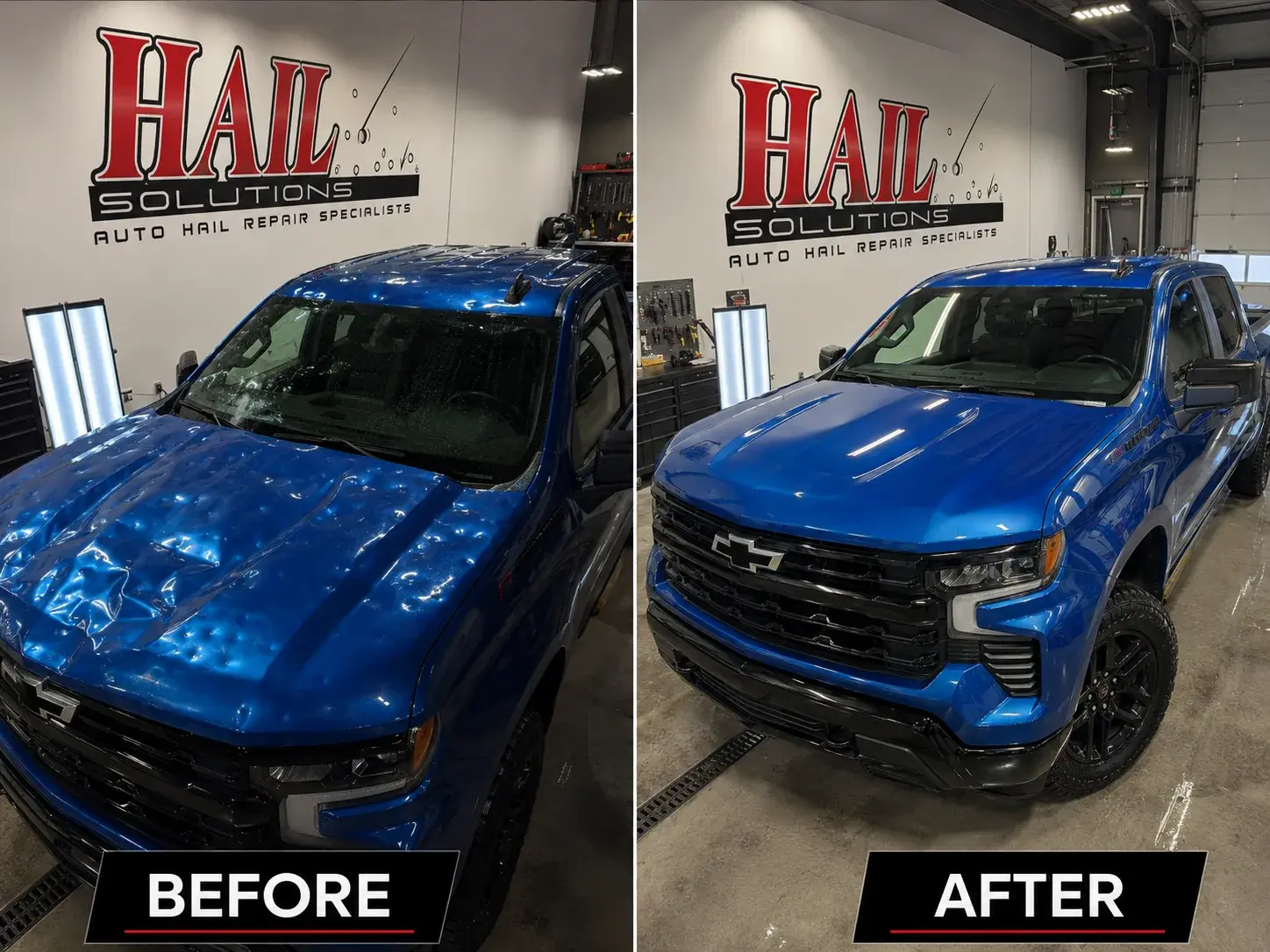
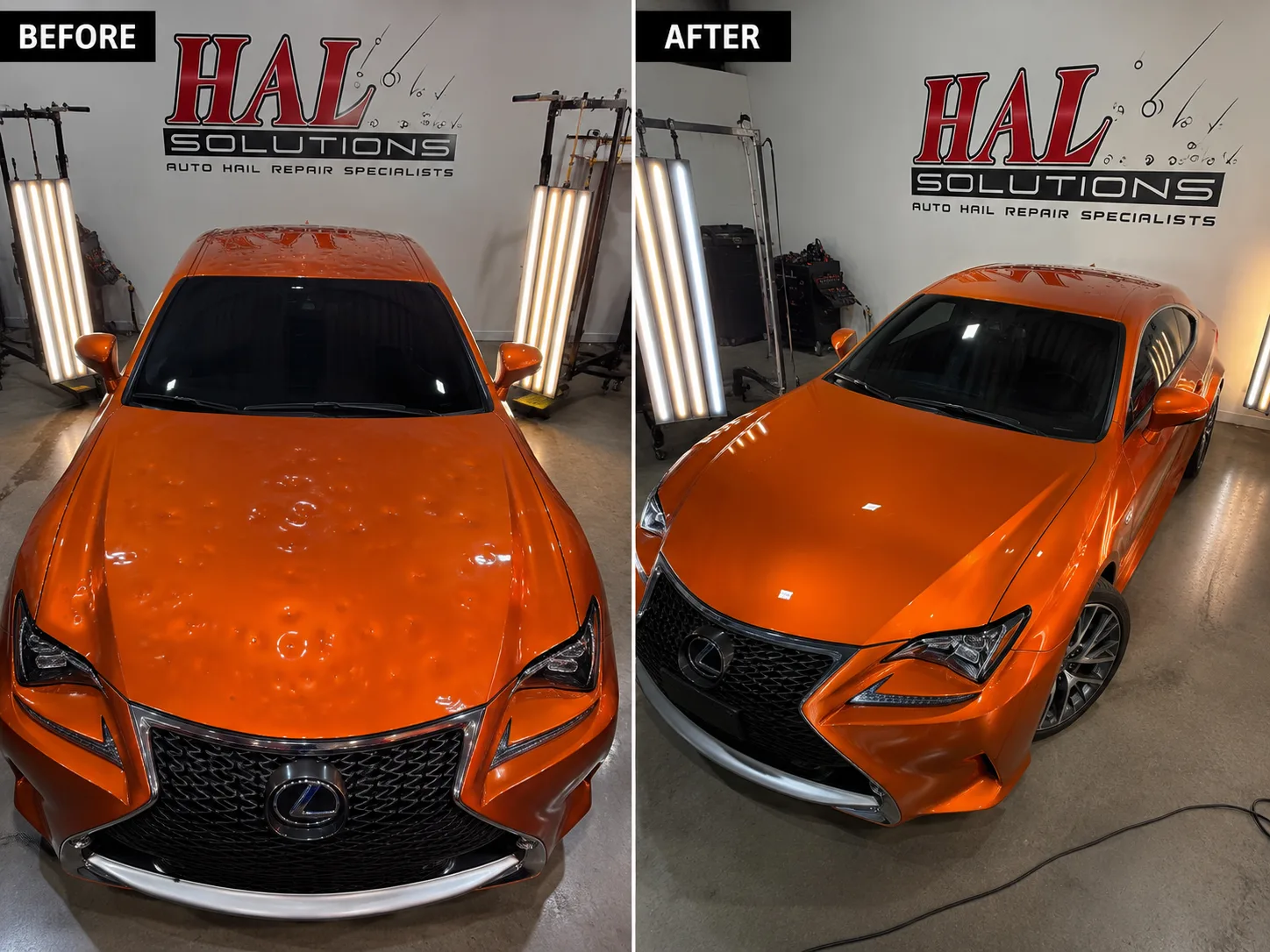
Severe hail saves, before and after
Actual vehicles restored at our Olathe shop — no stock photos. More in our repair results and shop gallery.
What "near-total-loss" means — and why the label is often wrong
The 300-dent mark is where most shops stop taking the work. It is also where the wrong estimate does the most damage.
The 300-dent mark is where the repair becomes a full-vehicle restoration
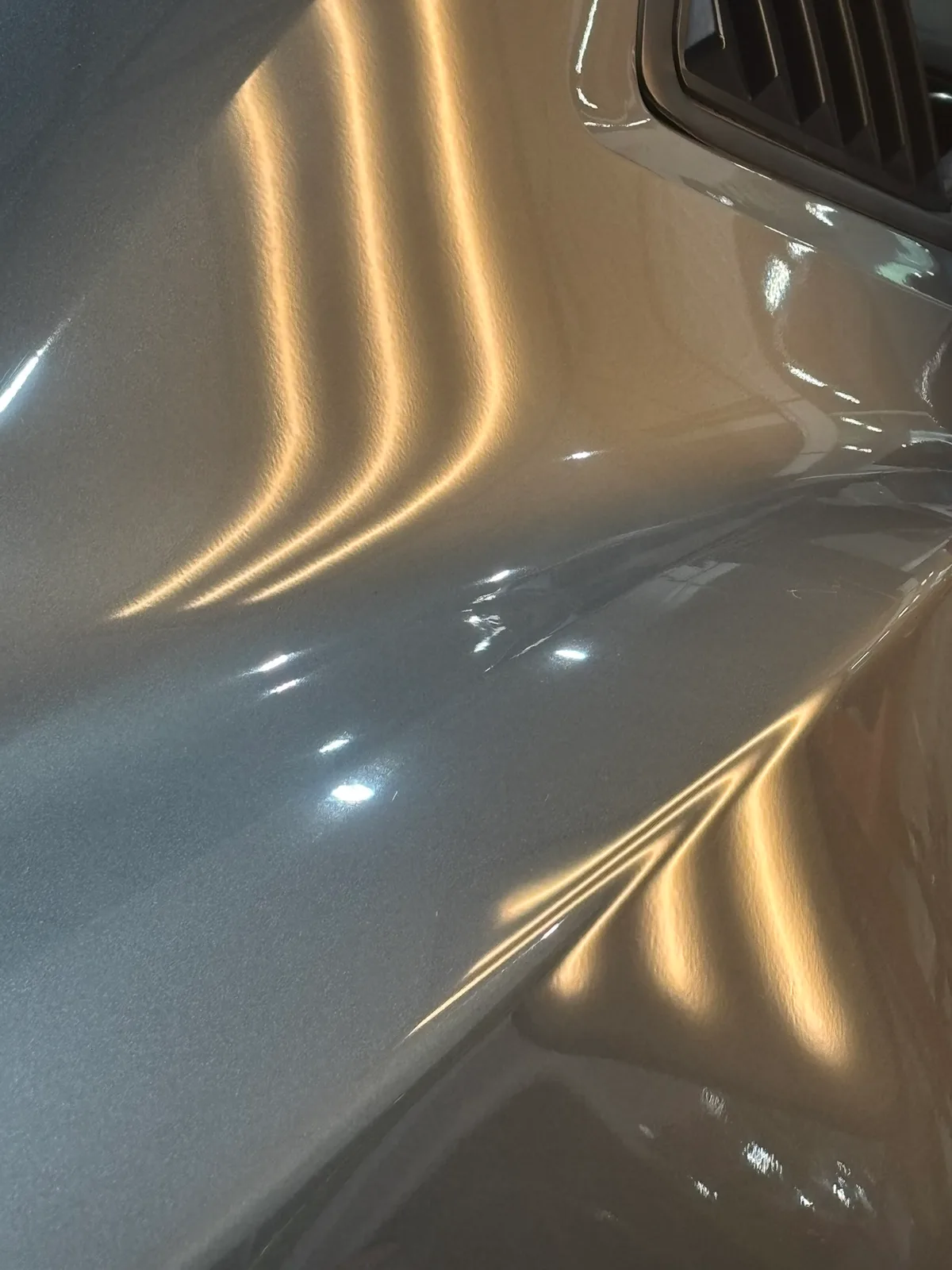
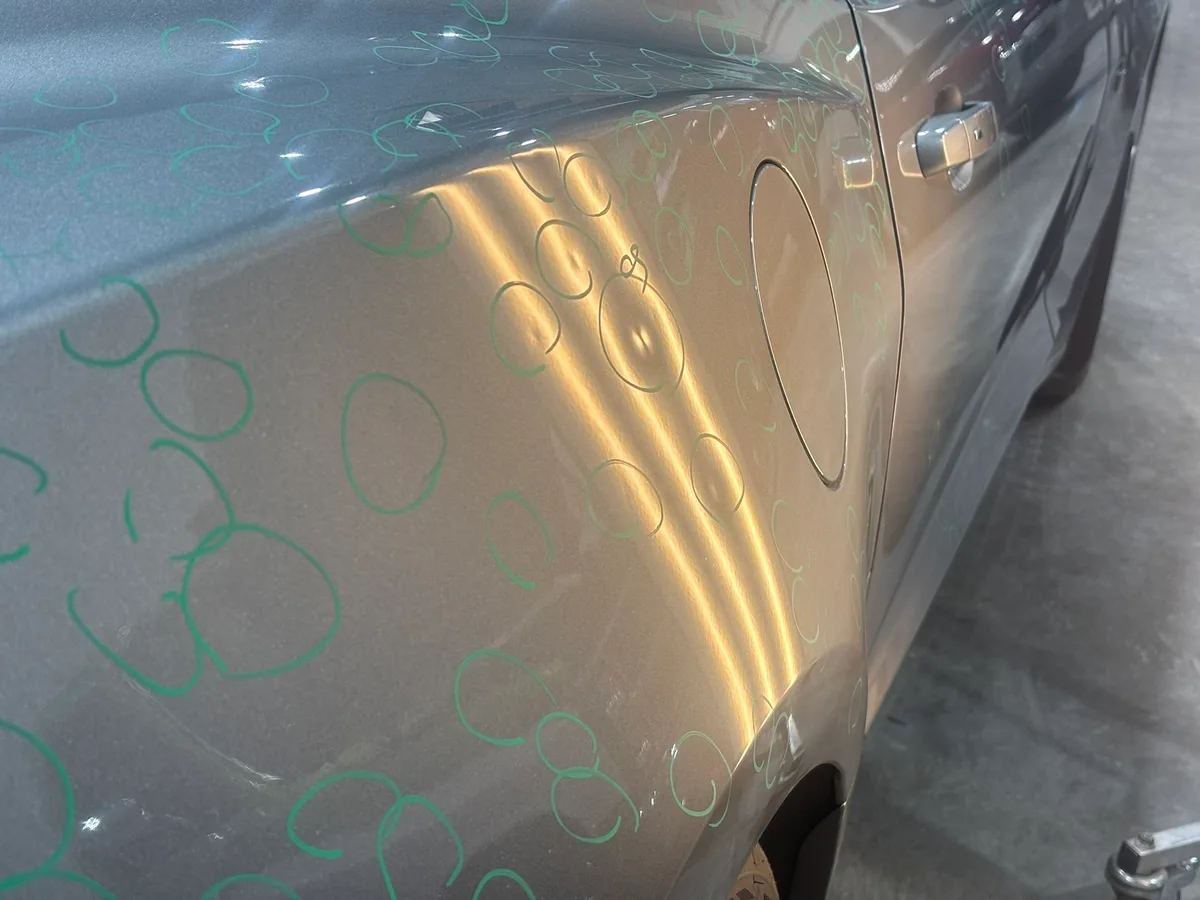
At that severity, the count adds up fast. Usually golf-ball hail or larger across every exterior panel, the hood alone may carry 80 to 100 dents and the roof can double that. When the whole vehicle crosses 300 dents the CCC ONE estimate jumps into the $8,000-plus range — and that is where insurers start running the total-loss calculation. Many body shops, and even many paintless dent repair shops, decline work at this level.
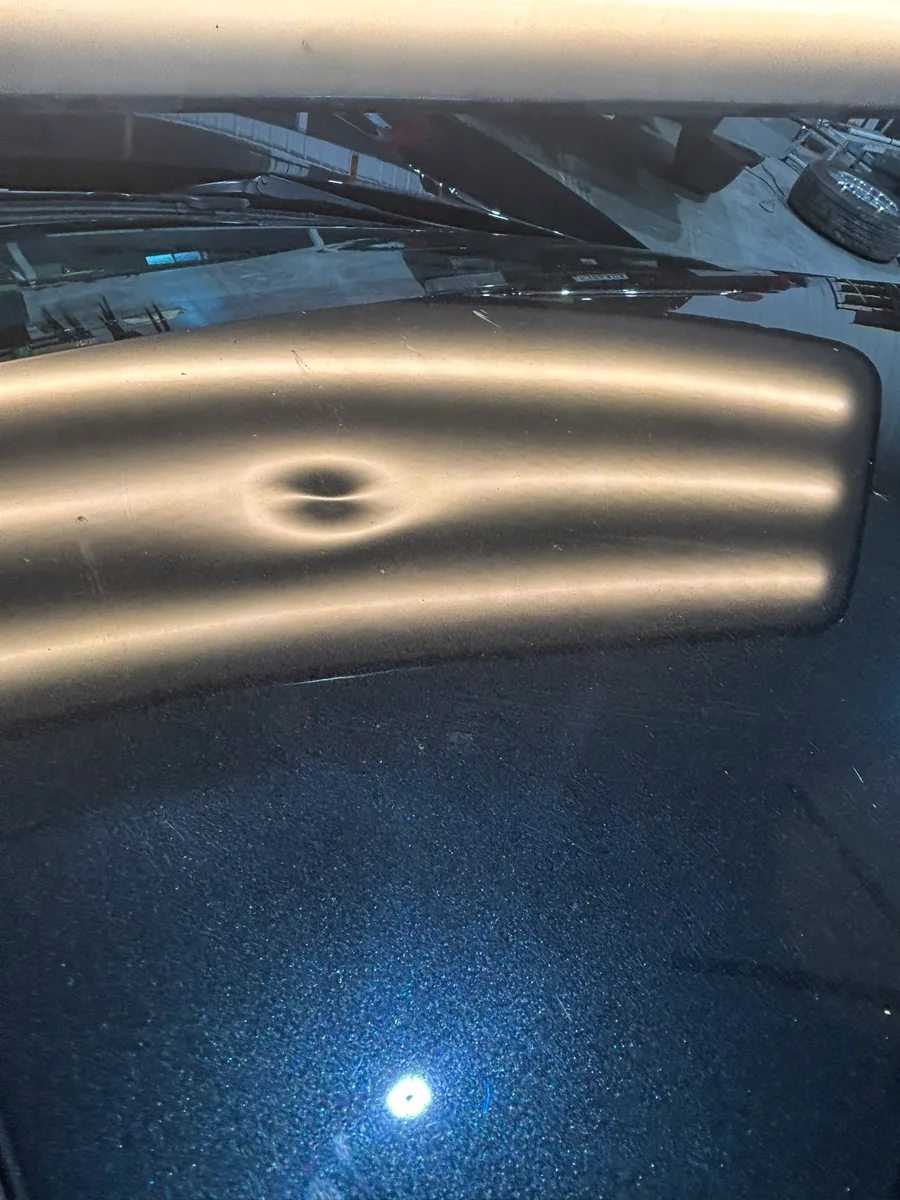
Vehicles get flagged incorrectly for two reasons. First, the initial estimate uses body-shop pricing — panel replacement plus paint plus labor — which inflates the repair far past the threshold. Second, many first inspections happen in a parking lot with no LED line boards, so the adjuster counts visible dents by eye and misses a large share of the real damage.
Bryan approaches every severe save the same way. A full re-inspection under controlled LED lighting, accurate panel-by-panel dent mapping, and a CCC ONE write-up that shows the real paintless dent repair cost. Over 23 years and 5,000-plus vehicles, Bryan Wilson has pulled cars back from total-loss paperwork that was already in motion.
Before you accept a total-loss call on severe hail
- The first number is usually body-shop math. Panel replacement plus paint inflates the repair far past what paintless dent repair actually costs.
- Parking-lot counts miss dents. Without LED line boards, an adjuster sees a fraction of the real damage and prices what they can see.
- An accurate estimate is the difference. Getting the real paintless dent repair cost in front of the adjuster before the title changes hands is what saves the car.
- Do not sign anything first. Have a shop that actually does this level of work look at it before you accept any offer.
Where the cost difference comes from
Same damage, two repair methods — and the method is what decides whether the total-loss math triggers.
Roof
Body shop: $4,000–$6,000+
Paintless dent repair: $2,500–$3,500
The panel that carries the most dents on a parked vehicle.
Hood
Body shop: $3,000–$5,000
Paintless dent repair: $1,500–$2,800
80–100 dents on a hood is common after golf-ball hail.
Full vehicle (300+ dents)
Body shop: $30,000+ if panels are replaced
Paintless dent repair: $8,000–$18,000
Steel; aluminum bodies add roughly 25%.
With comprehensive coverage, the claim covers the approved repair and you are responsible for your deductible. Past light damage, filing almost always makes sense — and on severe damage, an accurate paintless dent repair estimate is often the difference between a repaired car and a totaled one. Figures are typical ranges; every estimate is mapped on site under LED line boards.
How a severe repair works, step by step
You stay in control of the claim, and we carry the repair. You make the call to your insurer — it is your claim — and from the LED inspection through the pickup to the final walkthrough, the work lands on us. Here is how the seven steps go.
Document the damage
Photograph every panel in good light before you do anything else. On severe damage this record is what protects you when the first estimate runs light.
We inspect it free
At your place or our Olathe shop. We map every dent under LED line boards and write it up in CCC ONE format — the count adjusters can verify.
You file your claim
You open it with your carrier — it is yours. We hand you the exact script for your insurer. We never file for you.
We document the full scope
Every panel, in the format adjusters expect, so the approved amount reflects 300-plus dents of real work — not a photo guess that triggers a total-loss call.
We pick up your vehicle
Free across the metro. For severe damage we bring it into the Olathe shop, where the lighting lets us reach every dent.
We do the repair
Bryan and the team work every panel by hand over several shop days. Factory paint preserved, no filler, no repaint.
We deliver it back
Cleaned, inspected, and looking like the storm never happened — with a lifetime warranty in writing.
Let us look at it first
If an adjuster has called your vehicle a total loss, do not sign the title over until a shop that repairs 300-plus dents has seen it. Start the free claim walkthrough, or call and ask for Bryan Wilson.
What customers ask when they think their car is totaled
My insurance said my car is totaled. Is it really?
Get a second opinion before you sign anything over. Estimators frequently flag severely hailed vehicles as total-loss from initial photo reviews that undercount the real repair and price it in body-shop terms. The threshold is 80% of actual cash value in Missouri (RSMo 301.010(55)(a)) and 75% in Kansas (K.S.A. 8-197(b)(2)(B)) for late-model vehicles — the repair cost would have to climb past that share of your car's current value. With an accurate paintless dent repair estimate in front of the adjuster, many vehicles headed for total-loss paperwork come in well under the line and get saved.
Read our total-loss guide, then start the free claim walkthrough — we will tell you straight whether the total-loss call holds up.
Can paintless dent repair really handle 300 or more dents?
Yes, when the damage profile fits. We have restored vehicles carrying 400-plus individual dents across every panel. What decides it is not the count — it is whether the paint is cracked, the metal is folded, or a panel is stretched past its elasticity. Dime-to-quarter dents in intact factory paint across the whole body is exactly what paintless dent repair is built to undo. A full-vehicle repair runs several shop days, and it avoids tens of thousands in panel replacement while keeping the original finish.
Will a severely repaired vehicle show up on CARFAX?
No. Paintless dent repair does not create a body-shop record, regardless of dent count. A 400-dent repair and a 50-dent repair both finish with no replaced panels, no repaint, and no filler. CARFAX flags body-shop work — replaced panels, painted surfaces, frame straightening — none of which happens here. The repair stays invisible to the vehicle history, which matters most on higher-value cars where resale depends on a clean record.
What is the largest hail repair you have done?
Vehicles dented across the entire body — hood, roof, trunk, all four doors, the quarter panels, and the fenders. At that scope a CCC ONE estimate climbs into the $12,000–$18,000 range, the work takes five to eight shop days, and we bring the vehicle into the Olathe shop rather than working it mobile. We have saved cars that arrived with the total-loss paperwork already started.
If yours looks like that, do not accept the first assessment — Bryan Wilson wants to look at it in person.
How do you price severe damage?
The CCC ONE matrix scales by dent count and panel count. Each panel falls into a tier — 31–50 dents, 51–75, 76–100, 100-plus — and prices accordingly. Oversized dents larger than a half-dollar are billed as separate line items. Aluminum bodies add roughly 25%, and an extended roof on an SUV or van adds about the same. Every estimate is mapped on site under LED line boards and submitted to your insurer in the format adjusters expect — nothing is counted by eye.
Do I have to come to Olathe, or will you pick the vehicle up?
Free pick-up and delivery anywhere in the Kansas City metro is part of the job. For severe damage we usually want the vehicle in the Olathe shop, where the LED line boards and controlled lighting let us map every dent — so we come to your driveway, office lot, or wherever the car sits, bring it in, and return it when the repair is done. You file the claim with your carrier; we never file it for you. Once it is approved, the repair is on us.
Read this before you accept any offer
Learn the process on your own terms.