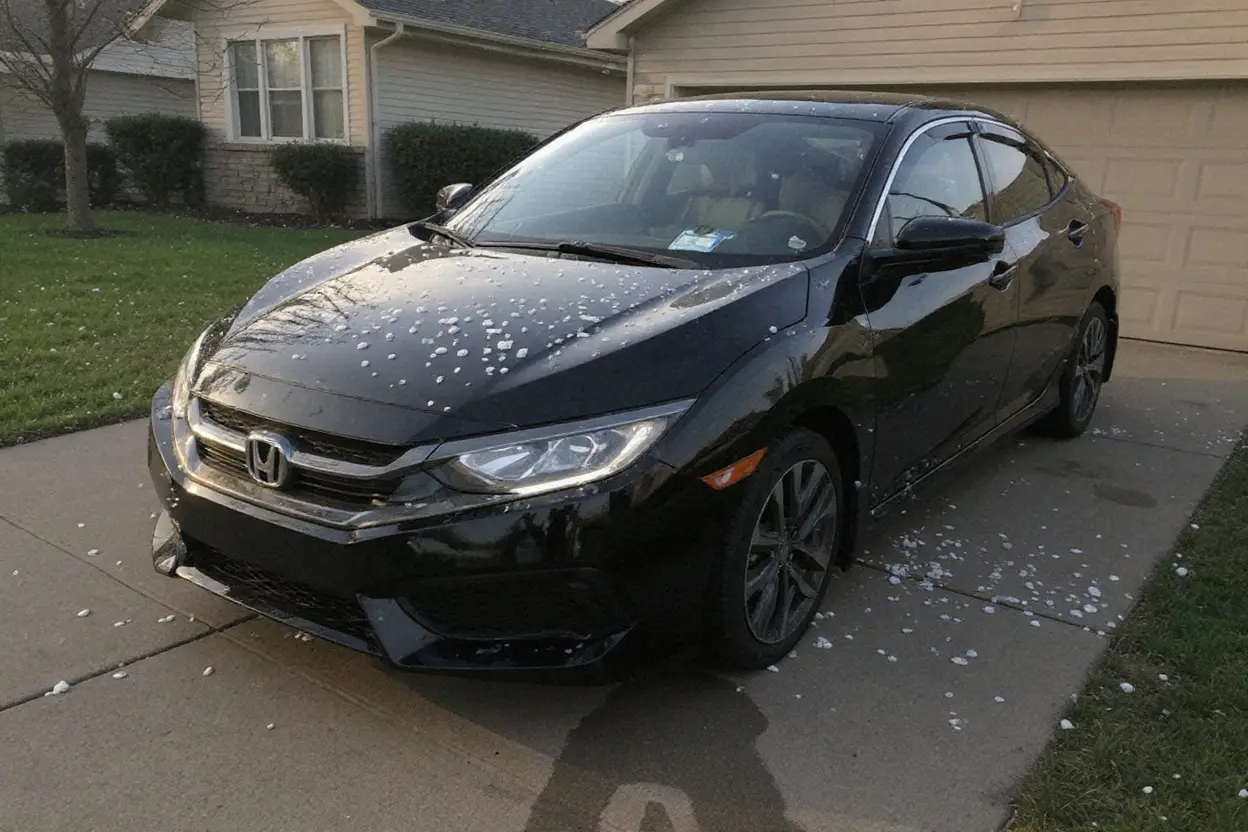
Here is the exact sequence we hand every first-timer who walks into our Olathe shop. Nine steps, none of them difficult on their own, but each one shapes how the claim lands with your insurer. After twenty-three years and more than five thousand vehicles, this is the process we have watched work — across every major carrier, every storm season.
Key takeaways
- No urgency. Hail damage is cosmetic and doesn't get worse — unless a window is broken, nothing about the next 24 hours is an emergency.
- Photograph the morning after. Eight to fifteen shots in low-angle light, even though phone photos miss sixty to seventy percent of the damage.
- Hail is a comprehensive claim, not collision. Rates typically do not increase when you file a comprehensive claim.
- You choose the shop. Kansas and Missouri anti-steering rules protect your right to pick any licensed shop — not the insurer.
- You file the claim; we handle the repair. A typical full claim runs two to four weeks from FNOL to keys back.
1. Don't panic, don't touch anything, and skip the car wash
Nothing about hail damage gets worse in the next twenty-four hours. Unless a window is broken or the interior is open to weather, there is no urgency at all. The dents are in the metal, and the metal is not going anywhere. The most common early mistake is running a hand over the dents — skin oil from your palm can make some dents harder to read under professional LED inspection later. Leave the surface alone.
If you have a garage, park in it. Not because the damage will worsen, but because it protects the vehicle from a second storm that could muddy the claim. No garage? Leave the car where it is and move to step two. Avoid the car wash for now: high-pressure water on hail-damaged paint can occasionally crack compromised clearcoat, turning a clean paintless dent repair into a repaint situation.
If a window is broken, handle that today. Cover it with plastic sheeting and packing tape — not a garbage bag, which tears — and call your insurer's glass line separately. Broken glass is a safety and water-intrusion problem that warrants same-day attention. Everything else can wait for morning.

2. How should I photograph the damage the morning after?
Phone photos in daylight miss sixty to seventy percent of the actual damage, and they still matter. Your first photos open the claim, establish a timeline, and document the vehicle's condition before anyone touches it. They do not need to be perfect. They need to exist.
Pull the car where low early-morning or late-afternoon sun rakes across the panels. Shadows reveal dents that bright overhead light flattens out. Shoot four wide shots — one per side — two or three angled shots of the hood and roof, and four to six close-ups of the worst spots. That is eight to fifteen photos and about five minutes of work. Our full documentation guide walks through the technique in detail.
If you can't get good light, photograph it anyway. Imperfect documentation beats none. You can always add better photos later, but the "morning after" timestamp on your first set proves you documented promptly — which matters if the claim is ever questioned.
3. Do I have the right coverage for hail?
Hail damage is a comprehensive claim, not collision — and that distinction is the most important one in the whole process. Comprehensive is the non-collision side of your policy: hail, wind, theft, falling trees, deer strikes. It is treated as an act of God, and rates typically do not increase when you file a comprehensive claim.
Open your insurance app or pull up your declarations page. Look for three things: confirmation that you carry comprehensive, your comprehensive deductible amount, and whether rental reimbursement is on the policy. Have all three answers in front of you before your first call to the insurer.
If you don't carry comprehensive, the claim stops here. Hail cannot be filed under collision coverage, so without comprehensive the repair would be on you. This is the moment calling us first makes the most sense — we will inspect for free, give you an honest estimate, and help you decide whether to repair now or factor the damage into a future trade-in.
4. Is it even worth filing a claim?
Sometimes the math says file, and sometimes it says wait. If your deductible is high and the damage is genuinely light, filing is not always the right move. A useful rule of thumb: if the estimated repair clearly exceeds your deductible by a couple thousand dollars or more, file. Closer than that, and the decision turns on vehicle age, your tolerance for cosmetic dents, and whether you plan to keep or sell the car.
Most first-timers don't realize you can call us before you file. We will inspect the vehicle for free, give you a realistic estimate range, and tell you honestly whether filing makes sense for your situation — no obligation to use our shop, no pressure. Some customers come in, learn the damage is genuinely minor, and decide not to file. That is a perfectly valid outcome.
Repair cost tracks severity. Light damage of fifty to a hundred mostly dime-sized dents usually runs $1,500–$3,500. Moderate damage of a hundred to three hundred mixed-size dents runs $3,500–$8,000. Severe damage of three hundred or more quarter-sized dents runs $8,000–$15,000 or higher. If your deductible is modest and you are looking at moderate damage, filing is almost always right. Our Should I File tool lets you run the numbers yourself.
5. What happens when I call my insurer to file?
FNOL — First Notice of Loss — is the one insurance call you make on this claim. It opens the claim, assigns a claim number, and starts the process. From there, the conversation is between the shop and the insurer, and you step out of the middle.
Have these ready before you call: the storm date, your vehicle year, make, and model, your comprehensive deductible, and your photos if the carrier asks. Most major carriers let you file in their app instead of by phone — State Farm, GEICO, Progressive, and USAA all offer app-based FNOL. If you would rather call, each carrier's claims number lives on our insurance hub.
The call itself takes ten to fifteen minutes. The representative asks standard questions — the storm date and location, where the vehicle was parked, whether you have photos, and which shop you want. At the end you receive a claim number. Write it down, screenshot it, email it to yourself; that number is the key to everything that follows.
Every carrier will try to steer you toward its preferred network. That is the Direct Repair Program, and the adjuster may frame it as a recommendation, a convenience, or even a requirement. It is not a requirement. Kansas and Missouri anti-steering rules protect your right to pick any licensed shop. You choose — not the insurer.
6. Should I pick a paintless dent repair specialist or a body shop?
A body shop repairs hail with filler, sanding, and repaint — the wrong tool for this job. That route takes weeks, files a body-work record on CARFAX, and can trim your resale value by five to fifteen percent. Paintless dent repair handles the same damage in a fraction of the time, keeps your factory paint intact, and leaves no CARFAX flag. For hail specifically, paintless dent repair is what you want.
The difference runs deeper than most people expect. A body shop fills the dents, sands the panels, and repaints — it looks fine from five feet, but it is no longer the factory finish, and any dealer or buyer who looks closely will see the work. Paintless dent repair pushes the metal back to shape from behind the panel, so the original paint layer is never disturbed. No filler, no repaint, no CARFAX entry. The full comparison lives here.
Not every paintless dent repair shop specializes in hail. General technicians handle door dings and parking-lot dents. Hail is a different animal — it calls for LED line-board inspection, CCC ONE estimating, panel-by-panel mapping, and supplement documentation. Ask any shop you are considering one question: "Do you handle the supplement, or do I?" If the answer is "you do," keep looking.
7. Why do I need a professional inspection on top of the insurer's?
The insurer's first estimate will come in low — that is how the process works, not a conspiracy. Adjusters inspect quickly, often in poor light, on a checklist that favors speed. They document what they can see, write an estimate, and send a check that typically covers sixty to eighty percent of the real repair cost. The remaining twenty to forty percent comes through the supplement.
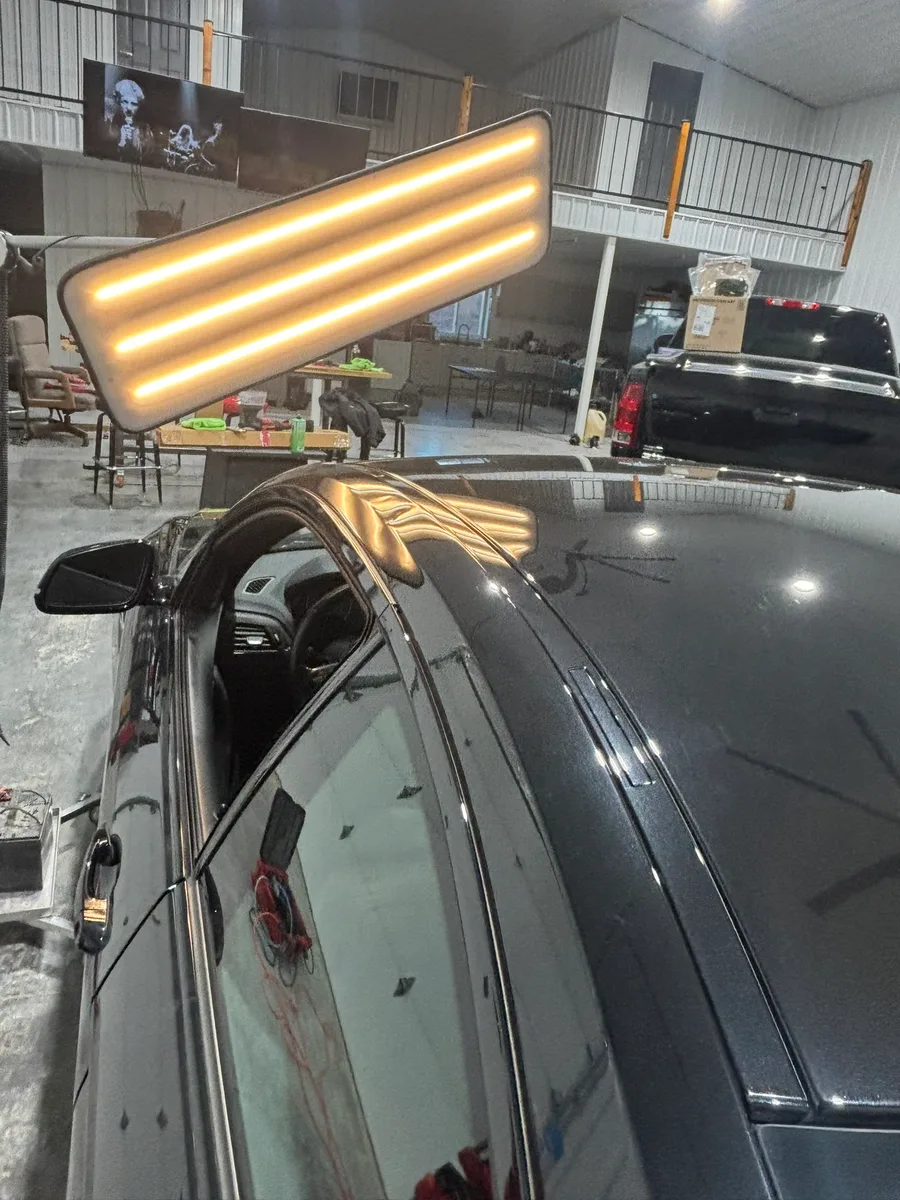
A professional shop re-inspects under LED line boards. The boards project parallel lines across each panel and reveal every dent, including the majority the adjuster missed in natural light. We map each panel in the CCC ONE format insurers expect, document it with photos, and submit the supplement. Most supplements are approved in one to two business days.
At our Olathe shop, the inspection takes about thirty minutes and is always free. You do not need a claim number to get inspected — come in before filing, after filing, or while you are still deciding. The inspection gives you real numbers instead of guesses, and if you choose us for the repair, it becomes the foundation of the supplement that gets your claim covered in full.
8. Who handles the back-and-forth with the insurer?
Supplement submission, adjuster questions, follow-up documentation — that part is on the shop. You sign a one-page work authorization that lets us communicate with your insurer about the repair, and then you step out of the day-to-day. We text you at each milestone, so you are not sitting on adjuster calls or learning insurance jargon. The claim stays yours; we coordinate the repair side of it.
This is where choosing the right shop pays off. A shop that documents supplements well gets the repair covered in full. A shop that handles them poorly leaves a gap between what the insurer paid and what the work actually costs. The supplement is documentation-heavy and demands real knowledge of how CCC ONE estimates read and how to respond when an insurer questions a line item.
You hear from us at every step. When the supplement goes in, when it is approved, when the repair is scheduled, when the vehicle enters the bay, and when it is ready. You are never in the dark, and if anything changes — an extra panel turns up, an approval runs long — you hear about it the same day.
9. How long until I get my car back?
A typical full claim, from FNOL to keys back, runs two to four weeks. Roughly half of that is supplement approval, which is waiting rather than working — the insurer reviews the documentation and issues payment, usually within three to seven business days. Actual repair time depends on severity: a few hours for light damage, one to three days for moderate, three to seven days for severe.
If your policy includes rental reimbursement, activate it now. Call your insurer and ask them to open the rental portion of the claim. Most comprehensive policies that include rental coverage reimburse a set daily rate for the length of the repair, and the rental company bills the insurer directly. Enterprise, Hertz, and National all handle direct billing. Start the rental when you drop the vehicle off and return it at pickup.
When you collect the car, inspect it under the same low-angle light you photographed it in. Go panel by panel. We do a final quality check under our line boards before releasing any vehicle, but your eyes are the last approval. If anything looks off, say so before you drive away — it goes straight back in the bay.
The first 48 hours, in one checklist
The first two days after a hail event set the tone for everything after. Here is the condensed version you can screenshot and follow.
- Day of the storm. Park in a garage if you can. Cover any broken window with plastic sheeting. Don't touch the dented panels. Skip the car wash.
- Next morning. Photograph the vehicle in low-angle light — eight to fifteen shots: four wide, two or three angled of the hood and roof, four to six close-ups. Back the photos up to email or the cloud.
- Same day. Open your insurance app. Confirm comprehensive coverage. Note your deductible. Check for rental reimbursement.
- Day 1–2. Call us at (816) 451-1455 or use the claim walkthrough. Get a free inspection and an honest estimate before you call your insurer.
- Day 2–3. File the FNOL by app or phone. Write down the claim number. Decline the Direct Repair Program referral and tell them you have chosen your own shop.
- Day 3–5. Drop the vehicle off, sign the one-page authorization, and activate the rental if you have it. We take it from there.
What not to do — the common first-timer mistakes
Every item here comes from a real customer conversation, and every one is avoidable. None are deal-breakers; a few minutes of information heads them all off.
- Don't treat the first estimate as final. The insurer's first check is an installment, not the total. The supplement — where the shop documents what the adjuster missed — typically adds twenty to forty percent. Depositing that first check and assuming you are done can leave thousands on the table.
- Don't take hail to a body shop. Filler and repaint create a CARFAX record and cut resale value, while paintless dent repair keeps the factory paint and leaves no history. For hail, paintless dent repair is the right method in nearly every case. The one exception: if hail cracked the paint through to bare metal on a panel, that panel may also need touch-up.
- Don't sign with the first person who knocks on your door. After a major storm, traveling techs canvass neighborhoods with on-the-spot estimates and same-week promises. Some are skilled; many are not; and all of them are gone in six weeks when you need warranty service. Read the full comparison before you commit to anyone.
- Don't wash the car before you photograph it. High-pressure car washes can crack compromised clearcoat on damaged panels. Hand washing is fine — just wait until your photos are taken and backed up.
- Don't sit on it past thirty days. Most policies allow thirty to sixty days to file. Day three is normal; day forty-five starts raising questions; day ninety risks denial. There is no rush, but there is a window.
- Don't lose sleep over your rates. Hail is a no-fault, act-of-God comprehensive claim, and in most cases rates do not increase after a comprehensive-only claim. If your insurer suggests otherwise, ask for it in writing.
How does Kansas City's hail season change the timing?
Kansas City's hail season runs from late March through August, with peak activity in May and June. The metro sits where warm Gulf moisture collides with cold fronts dropping out of the plains — the recipe for supercells that drop hail from dime-sized to far larger. The I-35 corridor through Olathe, Lenexa, and Overland Park takes regular hits because storm tracks here tend to move from southwest to northeast.
After a major event, every paintless dent repair shop in the metro books out within forty-eight hours. Wait times jump from next week to six weeks out almost overnight. That surge is exactly what draws traveling techs to the area, and it is why getting in early matters. Call on day two and you slot into the first wave; call in week three and you are behind everyone who called first.
The practical move is to call or submit online within forty-eight hours of the storm — even before you have filed, even if you are not yet sure the damage is bad enough. Getting on the schedule early gives you room to maneuver. You can always cancel a slot; you cannot always find one once demand peaks.
What does the first insurance call actually feel like?
The FNOL call is straightforward, and knowing the flow takes most of the stress out of it. Most first-timers worry they will say the wrong thing and hurt the claim. That almost never happens.
The representative starts with identifying questions — policy number, name, contact details — then asks about the event: the storm date and rough time, where the vehicle was parked, and whether you have photos. Answer honestly and simply. You do not need to count dents or guess at severity; that is the shop's job.
Then they ask whether you've chosen a shop, and the Direct Repair pitch arrives. The rep may say "we partner with such-and-such for your convenience." Decline politely: "I've already chosen a shop, thank you." If they push — "we can only guarantee work at our facility" — name your protection: "I understand, but I'm exercising my right to choose my own shop." That ends it. The call runs ten to fifteen minutes, and you leave it with a claim number and usually an email summary — save both, and share the number with us when you submit through the walkthrough.
What Bryan tells every first-timer
You're going to be fine. I know that sounds like the thing everyone says, but I have been doing this for twenty-three years and watched this exact situation play out more than five thousand times. The car looks rough, your stomach drops, you start searching and the information piles up. Here is what I want you to hear: this is a solved problem.
Hail damage is cosmetic. Your car is safe to drive, the repair is straightforward, your comprehensive coverage almost certainly applies, and filing a comprehensive claim typically does not move your rates. The whole thing runs two to four weeks, and for most of that you are not doing anything — we are.
The hardest part of hail damage is figuring out what to do next, and that's what this guide is for. If you are still unsure after reading it, that is what we are for. Call (816) 451-1455, use the claim walkthrough, or drive to the shop at 2109 E Kansas City Rd, #22, in Olathe. We will look at the car, tell you exactly what you are dealing with, and walk you through the next step — no obligation, no pressure, no cost for the inspection.
Take a breath. You file the claim, we handle the repair, and your car comes back like the storm never happened.