Key takeaways
- Most hail damage repairs with paintless dent repair — the dividing line is paint integrity and metal stretch, never dent count.
- Four situations send a panel to a body shop: cracked paint, a sharp body-line fold, prior filler, or replacement costing less than repair.
- Aluminum repairs too, with heat-assisted technique and a 25 percent material markup.
- Insurance total-loss thresholds are 75 percent of actual cash value in Kansas, 80 percent in Missouri — a paintless dent repair estimate rarely reaches that line.
- LED line board inspection is the only accurate way to know — the naked eye misses most hail damage.
What can paintless dent repair handle?
Any dent where the paint is intact and the metal has not been stretched past its elastic limit is a candidate for paintless dent repair. That covers the vast majority of hail damage, because hailstones create round, relatively shallow impacts that compress the metal rather than tearing it. The factory paint flexes with the dent instead of cracking, and the metal keeps enough memory to be worked back into shape. In practice that means small, medium, and most large dents on flat panels — hoods, roofs, trunks, door centers — repair cleanly, along with dents on the gentle body curves of modern sedans and SUVs.
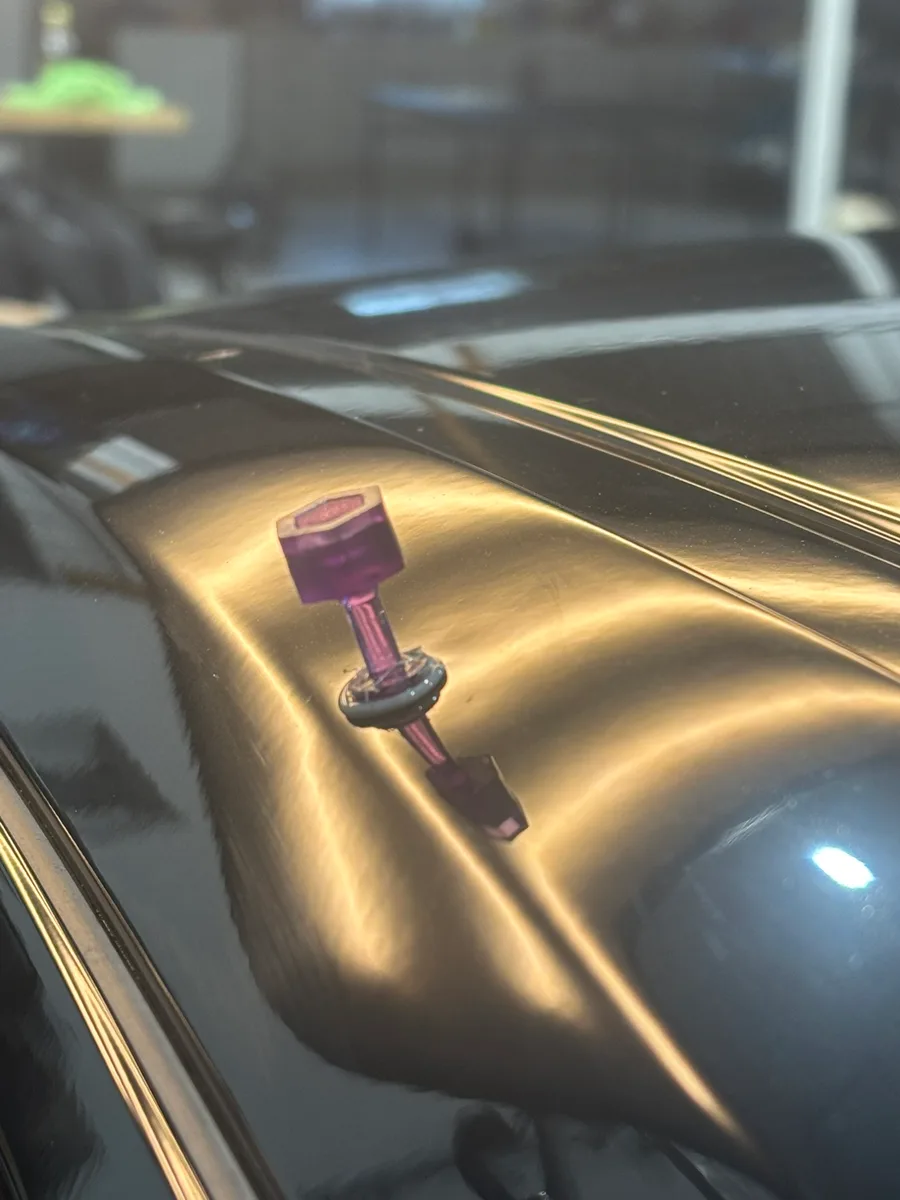
Dent count is not the limit people assume it is. We have completed repairs with 400-plus dents on a single vehicle when the damage profile was right, and aluminum and high-strength steel both repair with the right technique. Double-metal panels that have no rear access are worked with the glue-pull method instead of pushing from behind. The question is never how many dents there are; it is whether the paint held and the metal can return to its factory shape.
How does each panel respond differently?
Not every panel on a vehicle reacts to paintless dent repair the same way. Each one has its own curvature, metal thickness, and accessibility from behind, and all three change how well the process works. The hood is the most commonly hit panel and one of the friendliest to repair — large, mostly flat, and easy to remove for bench work where we can reach both sides of the metal. Even a hood with 80-plus impacts usually comes back completely, because it is typically single-layer steel with good elasticity.
Roofs are the second most common target and the trickiest to access. The headliner and roof braces sit directly under the skin, so we thread specialized long-reach tools between the supports. On most sedans and SUVs the roof repairs well; panoramic sunroofs complicate things, since the metal around the glass is limited and some dents near the sunroof rail sit on double-layered metal that calls for the glue-pull method. Trunk lids, by contrast, are highly repairable — removable, single-layer, and bench-friendly, most come off with four bolts and finish in well under an hour.
Doors, fenders, and quarter panels each have an easy zone and a hard zone. Door centers — the flat area between the body line and the lower edge — give the best results, while dents directly on a sharp horizontal crease are harder. Front fenders repair easily across the flat face, but the rolled edge by the headlight or wheel well can stretch in a way that resists pushing back. Quarter panels are welded to the body and cannot come off, so all of that work happens on the vehicle through wheel-well openings and trim removal; the flat center repairs well, and the tight curves near the wheel arch are where the glue-pull method earns its place.
What can paintless dent repair not handle?
Four specific situations account for nearly every limit of the technique.
- Cracked or chipped paint. If a hailstone broke the clearcoat or knocked paint loose, paintless dent repair cannot restore the paint layer, and the panel has to be sanded and resprayed — body-shop work. This is rare, since hail usually dents intact paint rather than cracking it, but golf-ball-size hail at high velocity can crack the finish, especially on older vehicles where the clearcoat has already weathered.
- A sharp body-line fold. A dent right on the sharpest crease of a body line — the front edge of a fender, a pickup bed rail — can fold rather than dimple, because the crease acts as a stress concentrator. Shallow dents along gentler lines repair fine; sharp-fold dents may need panel replacement.
- A panel previously repaired with body filler. The filler absorbs the pushing force from behind and the tool meets hardened filler instead of the metal skin. Under LED inspection we can spot prior filler by how the metal responds.
- Damage where replacing the panel simply costs less than repairing it. This is uncommon on hail, because hail spreads damage across the whole vehicle rather than concentrating it on one panel, but it does come up on single-panel catastrophes. If a hood has 100-plus dents including several deeply stretched ones, a new hood plus paint can cost less than the labor hours the repair would take — and it gives you a factory-fresh surface.
Does the type of metal change the answer?
The metal under your paint affects how the repair is done, how long it takes, and what it costs. Standard mild steel is the easiest material to work — it has excellent memory and wants to return to its original shape when pushed from behind. Most vehicles on Kansas City roads are predominantly mild steel, which is why their repairs are the fastest and most affordable. Newer vehicles add high-strength and ultra-high-strength steel in structural areas for crash safety, and that steel resists repair tools the same way it resists deformation: the dents still come out invisibly, but the labor hours run higher.
Aluminum takes a fundamentally different approach. It does not share steel's elastic memory; it work-hardens when deformed, so the dented area becomes stiffer than the metal around it. We use magnetic induction heating to carefully warm the aluminum until it is workable again, then reshape it with the repair tools. The 25 percent markup on aluminum hail repair reflects that added time and equipment. Vehicles with aluminum panels include the Tesla Model 3, Y, S, and X, the Ford F-150 hood and body panels, the Audi A8, and several luxury SUVs.
What about a hybrid repair?
The real world does not always sort neatly into a paintless dent repair vehicle or a body-shop vehicle. Plenty of hail-damaged vehicles benefit from a hybrid: paintless dent repair on the panels where the paint is intact and the dents are workable, body-shop work on the one or two panels where the paint cracked or the damage sits on an unrepairable edge. Instead of a body shop repainting eight panels and creating eight CARFAX entries, the vehicle gets paintless dent repair on six or seven panels with no CARFAX record and body-shop work on one or two.
That approach lowers the cost, lowers the insurance estimate, and minimizes the CARFAX impact. When our inspection shows that a panel or two need body-shop work, we handle the paintless dent repair portion ourselves and refer those specific panels to a body shop we trust. You get one coordinated repair instead of choosing one path or the other. Our guide to whether hail repair shows on CARFAX covers why keeping panels out of the body shop protects your vehicle history.
When does insurance say "replace the car"?
Insurers declare a total loss when the repair estimate crosses a set percentage of the vehicle's actual cash value. In Kansas that threshold is 75 percent of actual cash value; in Missouri it is 80 percent. Once the estimate passes that line, the insurer pays you the vehicle's value minus your deductible instead of paying for the repair. The math is where method matters: a body-shop estimate that replaces and repaints multiple panels climbs fast, while a paintless dent repair estimate is labor-hours rather than parts plus paint plus booth time, so it usually lands well under the threshold for the same vehicle.
That difference is exactly why a paintless dent repair inspection before accepting a total-loss declaration can save your vehicle. A total-loss payout hands you actual cash value minus deductible and takes away a vehicle that could have been repaired and driven for years; paintless dent repair keeps it on the road with the factory paint intact. Our total-loss guide walks through the calculation and how to ask for a second opinion before the claim closes.
What makes damage truly too severe?
Three physical conditions mark the boundary where the technique stops working.
- Stretched metal. When a hailstone hits hard enough, the metal at the center thins and expands past its original dimensions, and pushing it back leaves a raised crown ringed by low spots that will not return to flat. Under LED line boards a stretched dent shows a bright spot at the center where the metal is thinnest.
- Cracked paint. Even over perfectly repairable metal, a broken finish puts the panel into refinishing territory.
- Panel-edge damage on a tight radius. The edges of hoods, trunks, and fenders curve tightly, sometimes with a radius under half an inch, and a dent right on that edge cannot be reached from behind without wrinkling the metal. These are the dents we flag during inspection as a body-shop referral.
Everything short of those three conditions is, in nearly every case, repairable with paintless dent repair.
Why is LED line board inspection the only way to know for sure?
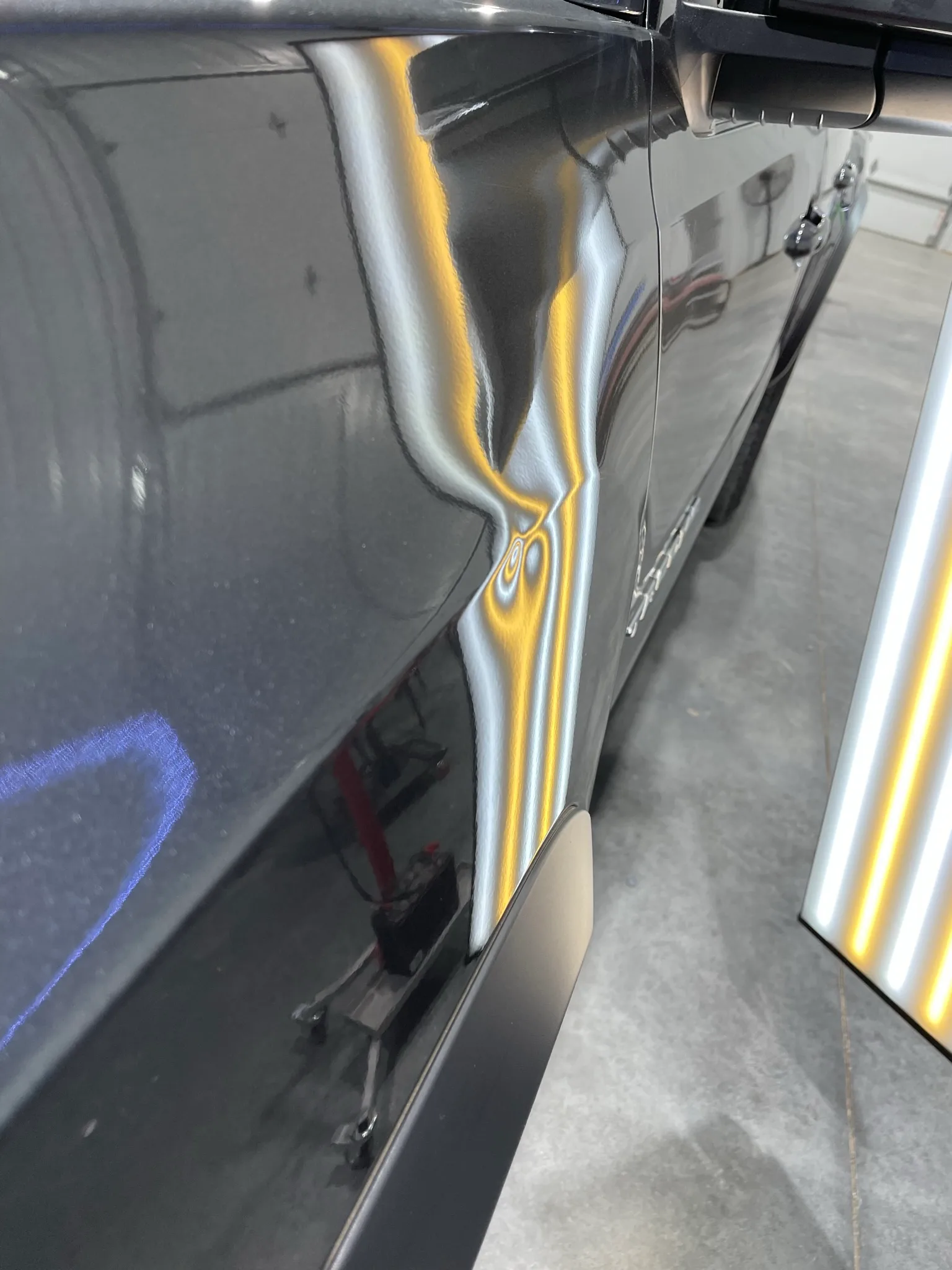
The naked eye misses most hail damage. That is a consistent finding across thousands of inspections, not an exaggeration. Hail dents compress the metal so gradually that they do not catch light the way a sharp crease does — under normal lighting a moderately damaged vehicle might show 30 to 40 visible dents, and under LED line boards the same vehicle reveals 150 to 200. The boards cast a controlled pattern of parallel light lines across the panel; where the metal is flat the lines stay straight, and any dent, even a fraction of a millimeter deep, distorts them into view.
An accurate dent count decides everything downstream. It sets the repair estimate, determines whether the vehicle crosses the total-loss threshold, sizes the timeline, and flags any panels that need a body-shop referral. It is also the same method adjusters use with the CCC ONE estimating system. Our inspection is free and takes about 30 minutes: we walk every panel, count every dent, note any paint issues or prior repairs, and give you a clear verdict — paintless dent repair, body shop, hybrid, or total-loss candidate. Start the free walkthrough to begin.
What has Bryan saved that others wrote off?
Over 23 years, Bryan has repaired vehicles that other shops, and sometimes adjusters, had already called unrepairable or total losses. The pattern is almost always the same: the first estimate was built on body-shop math — panel-replacement costs — and nobody got a paintless dent repair evaluation before writing the vehicle off. Full-size trucks with 300-plus dents are the most common save. An F-150, Silverado, or RAM has enormous panel area, so a body-shop estimate that replaces and repaints everything crosses the total-loss line quickly — yet those same flat panels are ideal for paintless dent repair.
Luxury sedans and SUVs are another frequent save. Their high actual cash value sets a high total-loss threshold, but their body-shop estimates run high too because OEM parts are expensive; paintless dent repair removes the parts cost entirely. The common thread in every save is simple: someone took the time to get a paintless dent repair evaluation before accepting the first estimate. If your vehicle has been declared a total loss, or a body shop quoted a repair that seems excessive, a 30-minute inspection is worth your time.
When should you go to a body shop instead?
There is no shame in a body-shop referral — some damage genuinely needs one. Widespread paint cracking across several panels calls for full-body refinish work that is beyond the scope of paintless dent repair. So does a vehicle with heavy filler on multiple panels from a prior repair, where the tools cannot work through the filler and the panels need stripping anyway. In rare cases, extremely large hail can damage structural supports beneath panels — hinges, roof-rail integrity, pillar deformation — and that is squarely body-shop territory.
Some customers also simply prefer one point of contact for a total redo. If a vehicle needs paintless dent repair plus multiple panel replacements plus repaint plus trim work, having a single body shop coordinate the whole job can make sense. We will tell you honestly which category your vehicle falls into. We do not take on work we cannot finish well, and we do not steer customers away from the path that genuinely serves them best — even when that path does not include us.
What should you do next?
If your vehicle has any hail damage, regardless of how severe it looks, a 30-minute LED line board inspection tells you definitively what is possible. We assess every panel, identify any areas that need a body-shop referral, and give you a clear picture of cost and timeline before you decide anything. Start the free claim walkthrough online, or stop by our shop at 2109 E Kansas City Rd, #22, Olathe.
If you are still deciding whether to file a claim first, start with the education. Our insurance hub walks through the process step by step, and our guide to how paintless dent repair works covers the rods, the glue pulls, and why the factory paint stays put. You file your claim; once it is approved, we handle the repair.